

When most people think about strength training, they think about muscle.
They think about size, appearance, performance, or the ability to lift heavier weights.
And while those things are part of the process, something much deeper is happening every time you train.
Your nervous system is adapting.
Every movement, every repetition, and every challenge sends signals between your brain, muscles, and body. Your nervous system is constantly learning from the experiences you give it.
It is asking:
How much pressure can I handle?
How do I respond when something feels difficult?
Can I stay focused when things become challenging?
How quickly can I recover and prepare for the next challenge?
This is one of the reasons strength training is so powerful.
You are not just building stronger muscles.
You are teaching your body that it can experience challenge, respond effectively, and return to a state of control.
A difficult set in the gym becomes a small lesson in resilience.
A weight that once felt impossible becomes proof that adaptation is happening.
A movement pattern that once felt unfamiliar becomes a reminder that your body is capable of learning.
This process creates a powerful feedback loop between your body and your brain.
You challenge yourself.
Your nervous system responds.
Your body adapts.
Then you become capable of handling more.
That is where strength training becomes more than exercise.
It becomes a practice of adaptation.
It becomes a way to build confidence, resilience, and a stronger connection between your mind and body.
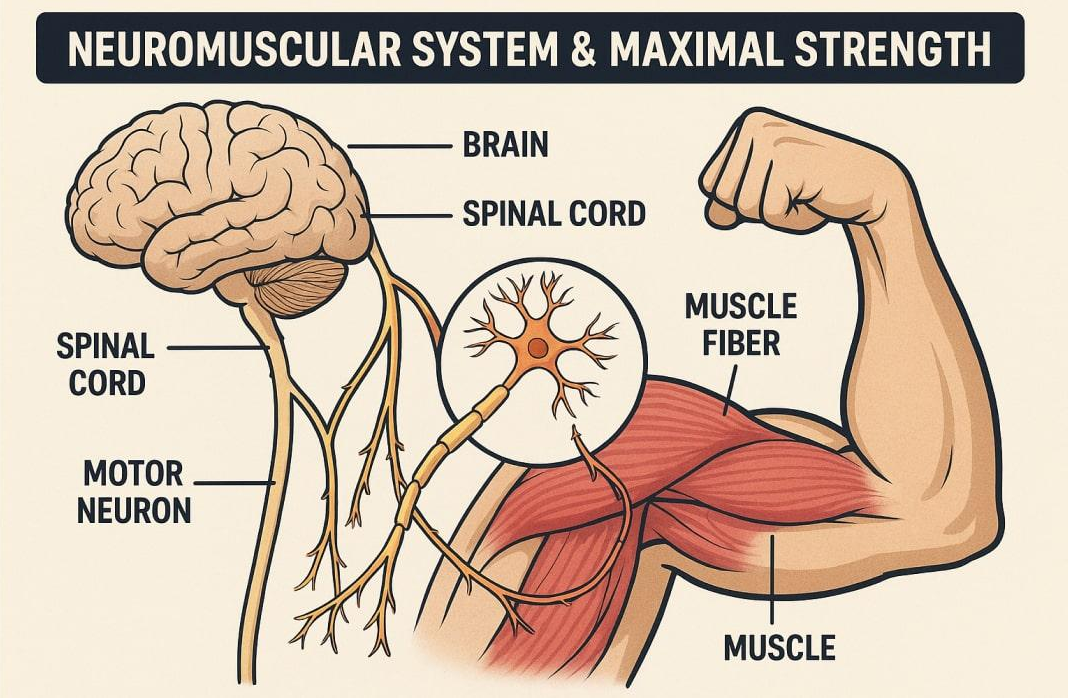
Your Nervous System Controls Performance
Your nervous system is the communication system behind every movement you make.
Before a muscle contracts, before you lift a weight, and before you react to a challenge, your brain and nervous system are already sending signals throughout your body.
This communication controls far more than strength alone.
Your nervous system influences coordination, balance, reaction time, focus, movement efficiency, and your ability to produce force.
This is why two people can have similar levels of muscle but perform very differently.
Strength is not only about how much muscle you have.
It is also about how effectively your nervous system can communicate with that muscle.
When you train with intention, you are not just creating physical changes.
You are improving the connection between your brain and your body.
Every repetition is an opportunity to practice control.
Every movement pattern teaches your body how to respond more efficiently.
Every challenge gives your nervous system new information.
Over time, this creates better coordination, improved confidence in movement, and a stronger ability to handle physical demands.
This is why strength training becomes more than building muscle.
You are strengthening the system that controls the muscles.
You are improving the connection between thought and action.
And you are teaching your body that it is capable of responding, adapting, and becoming stronger.

Controlled Stress Creates Adaptation
Stress itself is not always the enemy.
In fact, your body was designed to experience stress, respond to challenges, and adapt.
The problem is not stress alone.
The problem is when stress becomes constant, unpredictable, and something your body never gets a chance to recover from.
This is where strength training becomes such a powerful tool.
A well-designed workout creates a controlled challenge.
You intentionally place your body under stress.
You create a demand.
Your nervous system responds.
Then, through recovery, your body adapts.
You become stronger.
You become more capable.
You become better prepared for the next challenge.
This is the foundation of how progress happens.
A weight that feels difficult today becomes manageable over time.
A movement that once required focus becomes more natural.
A challenge that once felt overwhelming becomes something you know you can handle.
Your nervous system learns through experience.
Every time you approach a challenge, stay present, and complete the work, you are creating evidence that your body can respond.
This is why strength training is not just about building muscle.
It is also about building resilience.
The same adaptation process that helps you lift more weight can also help you handle the demands of everyday life.
Because life will always include stress.
The goal is not to create a life without challenges.
The goal is to develop the capacity to meet those challenges and return to balance.

Strength Training Can Improve Stress Tolerance
Daily life creates stress.
Deadlines.
Responsibilities.
Pressure.
Unexpected challenges.
The question is not whether stress will show up.
It will.
The question is how your body responds when it does.
A consistent strength training practice teaches your body how to experience challenge without immediately moving into overwhelm.
Every difficult set creates an opportunity to practice staying calm under pressure.
You learn how to control your breathing when something feels uncomfortable.
You learn how to stay focused when your body wants to quit.
You learn that discomfort does not always mean danger.
Over time, these experiences can help build confidence in your ability to handle difficult moments.
Your nervous system begins to collect evidence:
“I have faced challenges before.”
“I can stay present.”
“I can respond instead of react.”
This is one of the reasons strength training can be such a powerful practice for stress resilience.
The gym becomes more than a place where you build physical strength.
It becomes a place where you practice regulation.
You practice patience.
You practice discipline.
You practice showing up even when things are difficult.
Those lessons do not stay inside the gym.
They carry into your work, relationships, personal challenges, and everyday life.
Because the goal of strength training is not just to create a stronger body.
It is to build a person who is more capable of meeting whatever challenges come next.

Recovery Is Where the Change Happens
Training is the signal.
Recovery is the adaptation.
This is one of the most important concepts to understand when it comes to getting stronger.
Many people believe progress happens only when they are pushing harder.
They assume the hardest workouts create the biggest results.
But your body does not become stronger during the workout itself.
The workout creates the challenge.
Recovery is where your body has the opportunity to respond.
During recovery, your body repairs muscle tissue, restores energy, and allows your nervous system to prepare for future demands.
This is where adaptation happens.
Without proper recovery, the body can remain stuck in a constant state of demand.
You may continue training hard, but your ability to improve can begin to slow.
You may notice lower energy, decreased motivation, reduced performance, or feeling like your body is always trying to catch up.
This is why recovery is not a sign of weakness.
It is part of the training process.
Quality sleep, proper nutrition, hydration, movement, and moments of rest all provide signals that tell your body it has the resources needed to rebuild.
Your nervous system needs these signals as much as your muscles do.
A body that is constantly pushed without recovery eventually loses its ability to respond well.
However, a body that is challenged and restored becomes more resilient.
The goal is not to avoid stress.
The goal is to create a healthy rhythm:
Challenge.
Recover.
Adapt.
Grow stronger.
That rhythm is what allows strength training to create lasting change—not just in your muscles, but in your ability to handle the demands of life.

Performance Is More Than Output
When most people hear the word performance, they immediately think about results.
How much weight can I lift?
How fast can I run?
How many repetitions can I complete?
Those are certainly ways to measure progress.
However, true performance is much bigger than numbers.
It is about how well your entire system functions.
A healthy body is not defined by one great workout.
It is defined by how consistently it can respond, recover, and adapt over time.
Real performance looks like moving with confidence instead of hesitation.
Recovering well enough to train again tomorrow.
Staying focused when life becomes demanding.
Making good decisions even when you’re tired.
Showing up consistently, even when motivation comes and goes.
This is where the nervous system plays such an important role.
Your muscles may produce the movement, but your nervous system coordinates it, regulates it, and helps determine how efficiently your body performs under pressure.
When your nervous system is supported, your body moves with greater control, your recovery improves, and your ability to handle physical and mental challenges becomes stronger.
That is why performance is about far more than output.
It is about creating a body that is capable, resilient, and prepared for whatever life asks of it.
Because a strong body always depends on a strong system behind it.
The Research Behind This Article
Journal of Strength and Conditioning Research
Research examining how resistance training improves strength, neuromuscular adaptations, movement efficiency, and overall physical performance.
Sports Medicine
Systematic reviews examining the effects of resistance training on stress resilience, recovery, physical performance, and healthy aging across the lifespan.
British Journal of Sports Medicine
Research on physical activity, exercise prescription, recovery, and the role of strength training in improving long-term health and resilience.
Here’s The Path
Strength training is about far more than building muscle.
Every workout is an opportunity to teach your body how to respond to challenge, recover well, and become more resilient.
Your nervous system is paying attention to every repetition, every movement, and every recovery period. Over time, those experiences shape not only how you perform in the gym, but also how you respond to the demands of everyday life.
The goal isn’t to train harder at all costs.
The goal is to train with purpose.
Challenge your body.
Respect recovery.
Move consistently.
Build strength that lasts.
When you support your nervous system alongside your muscles, you don’t just become stronger—you become more capable.
And that strength reaches far beyond the weight room.
It shows up in the way you handle pressure, recover from setbacks, stay present with your family, and continue showing up for the life you’ve been called to live.
That’s the path.
Continue Your Journey
Keep building your understanding of how movement, recovery, and nervous system health work together:
2. Progressive Overload: The Simple Principle Behind Getting Stronger
3. Strength Training Schedule: How Often Should You Train?
4. Exercise Recovery Tips: How to Recover Faster and Train Better
5. The Hidden Warning Signs Your Nervous System Needs Help
Start Here
If you’re looking for a simple place to begin, download the FREE Full Armor Nervous System Reset Guide.
Inside you’ll discover practical daily habits to help regulate your nervous system, reduce stress, improve recovery, and reconnect with the person you were created to be.
Download the FREE guide:
https://fullarmorhq.com/free-guide/
If You Want To Go Deeper…
Reading about these principles is a great first step.
Living them is where real transformation happens.
The Full Armor 21 Day Method was created to help you build a daily rhythm that supports your nervous system, strengthens healthy habits, and creates lasting change from the inside out.
Inside the program, you’ll learn how to:
- Regulate your nervous system through practical daily habits
- Build consistency with movement, recovery, and intentional routines
- Develop greater resilience to stress and everyday challenges
- Create a stronger foundation for your physical, mental, and spiritual well-being
This isn’t another quick fix.
It’s a practical framework for helping you become stronger, calmer, and more resilient—one day at a time.
Explore the Full Armor 21 Day Method:
https://fullarmorhq.com/fullarmormethod/
No responses yet